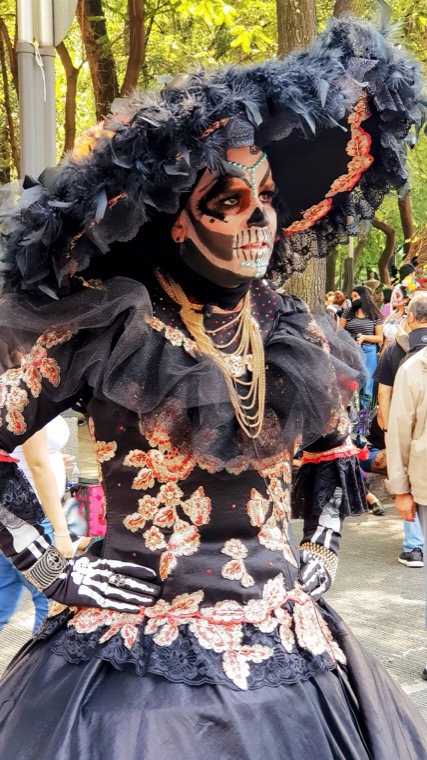
Day of the Dead Oaxaca is a family observance rather than a show: from 31 October to 2 November, and for about a week either side, the city and the villages of the Valles Centrales build ofrendas at home, fill the markets with cempasúchil and pan de muerto, walk in costumed comparsas through the neighbourhoods, and spend the nights of 31 October and 1 November keeping candlelit vigils at the graves of their dead. Visitors are welcome at most of it, provided they arrive as guests.
This guide sets out what happens and when, how to attend without intruding, how to reach Oaxaca from Mexico City, what a week costs, and how the tradition differs from the parade in the capital. It draws on the UNESCO inscription, the Oaxaca state and municipal programmes, and our own years of attending and reviewing events for the Find a Festival directory.
What is Día de Muertos, and why is Oaxaca the place to see it?
UNESCO inscribed the "Indigenous festivity dedicated to the dead" on the Representative List of the Intangible Cultural Heritage of Humanity in 2008, having first proclaimed it in 2003. The UNESCO entry describes a celebration held from the end of October to the beginning of November in which families "facilitate the return of the souls to Earth by laying flower petals, candles and offerings along the path leading from the cemetery to their homes", and in which the favourite dishes of the dead are set out on home altars and at the graves. It is explicit that the practice belongs to Mexico's Indigenous communities and fuses pre-Hispanic ritual with the Catholic calendar brought in the sixteenth century.
Oaxaca matters because that Indigenous continuity is unusually intact. The state has sixteen recognised Indigenous peoples, and the Zapotec and Mixtec villages ringing the capital have kept their own cemetery customs rather than adopting a single citywide event. The state tourism secretariat's 2025 programme, published on the Oaxaca government site, ran from 25 October to 4 November, listed more than 140 activities, and expected around 89,000 visitors and an economic impact above 380 million pesos. What visitors actually remember is a cemetery at 2 am.
We list the event as Día de Muertos in the directory, under cultural festivals, and it anchors our Mexico country page. Locals say Día de Muertos; Día de los Muertos is the form that has spread abroad, and the shorter one is what is printed on the programme.
When does Day of the Dead Oaxaca actually happen?
The fixed dates are the same every year. The night of 31 October into 1 November belongs to the angelitos, the souls of children, and the night of 1 November into 2 November to the adult dead; 2 November is Día de los Fieles Difuntos, All Souls' Day, when the souls depart. In practice the season runs longer: the ofrendas go up at home by 30 October, the markets peak in the last week of October, and several villages hold closing comparsas and muerteadas in the first days of November.
The state and city programmes fill the days around those dates with public events, and they vary each year. In 2025 the state calendar included a sand tapete in the atrium of the Jalatlaco church from 26 October to 3 November, the Verbena Xandú on the evening of 30 October, the Gran Comparsa and catrina contest at 6 pm on 31 October, nightly concerts at the Alameda de León, and a Mercado de las Ánimas from 30 October to 2 November. The city's own programme, under the banner Oaxaca Eternamente Viva, added a cempasúchil path along the Calzada de la República and lighting and projections at the Panteón General.
In 2026 the core nights fall on a Saturday and Sunday, which will make the cemeteries busier than in 2025. The state's detailed 2026 cartelera had not been published when we checked, and it normally appears in the second week of October. Arrive by 29 October and stay until at least the morning of 3 November.
What are the comparsas, and where do you see them?
A comparsa is a neighbourhood procession with a brass band, dancers in skeleton and devil costumes, giant puppets and, increasingly, a crowd of visitors walking behind. The Gran Comparsa organised by the state and city sets off from the historic centre on the evening of 31 October; stand on the Macedonio Alcalá or around the Zócalo and it will come to you. In our experience the pavements on the Alcalá fill an hour before the published start.
The barrio comparsas are the ones worth planning around. Jalatlaco, the cobbled neighbourhood just east of the centre, walks its comparsa on the evening of 1 November, and Xochimilco to the north and Cinco Señores to the south each have their own on 1 or 2 November. These are organised by the neighbourhoods, not the tourism office, so the times appear on painted banners and social media a few days before, and they run late and loud. The pattern we have found reliable is the Gran Comparsa on 31 October, then 1 November in a barrio.
The Etla valley north-west of the city does something different. San Agustín Etla, San José Etla and San Andrés Zautla hold muerteadas, all-night masked processions with bands and satirical speeches that start on the night of 1 November and continue past dawn. San Agustín now draws several thousand outsiders, closes its entrances in the early evening, suspends alcohol sales and has charged a visitor fee, so it needs a driver booked for the whole night and a willingness to stand in a cold field until 4 am. It is the most intense night of the week and not one we would recommend to a first-time visitor with children.
Which cemetery vigils can visitors attend, and on which nights?
Three cemeteries take most of the visitors, and each has its own night. Santa Cruz Xoxocotlán, a separate municipality about five kilometres south of the centre and next to the airport, holds its vigil on the night of 31 October into 1 November. The municipality's own 2025 notice names its three cemeteries as San Sebastián Mártir, Mictlancíhuatl and Monte Albán, opens them from 29 October, and asks visitors to "acudir con respeto a estos espacios, evitar sentarse sobre las tumbas, así como mantener limpios los camposantos", that is, to come respectfully, not sit on the graves, and keep the grounds clean. Visitors know the two central sites as the Panteón Viejo, the old walled cemetery with its ruined chapel, and the Panteón Nuevo across the road, and both fill with candles, marigolds, bands and food stalls from dusk until the early hours.
Santa María Atzompa, the pottery village on the hill north-west of the city, keeps its vigil the following night, 1 November into 2 November, and it is smaller, darker and quieter than Xoxocotlán, with far less of a spectator crowd. In the city itself the Panteón General, also called the Panteón de San Miguel, on the east side of the centre, is the municipal cemetery; in 2025 the city kept it open from 7 am to midnight on 31 October, 1 November and 2 November, and the busiest evening is 1 November, when the tombs in the arcaded walls are lit and the city stages music and projections at the gates. Every village in the Valles Centrales does something, and the further from the tourist route you go, the more you are a guest and the less an audience.
How do you attend the cemeteries respectfully?
A cemetery vigil is a family gathering at a grave. The people around you have spent the day cleaning the tomb and carrying flowers and food, and they are there to sit with someone they have lost. Visitors are tolerated, and in Xoxocotlán expected, but the tolerance depends on behaviour, and in our experience it has thinned as the crowds have grown.
The rules are simple. Do not step on graves, sit on tombs or move candles, flowers, food or photographs. Do not drink to excess or treat the vigil as a party, even though there are bands and mezcal. Lower your voice, keep to the paths, and if a family offers you food or a drink, accept it, thank them and move on. Costume and face paint belong to the comparsas and were never a cemetery tradition; if you paint your face as a catrina, keep it for the streets.
Photography is where visitors most often get it wrong. The Xoxocotlán cemetery at midnight is one of the most photographed scenes in Mexico, and the families have every reason to be tired of lenses. Ask before photographing a person or an attended grave, accept a no without argument, never use flash, and never fly a drone; flowers, candles and the general scene from the paths are fine. We have found that putting the camera away for the first half hour, and then asking one family, produces better pictures and a better night than working the rows.
Where do you find the markets, the pan de muerto and the sand tapestries?
The Central de Abastos, the huge wholesale market west of the centre, is where Oaxaca buys its ofrenda. In the last week of October a section of it becomes a flower market of cempasúchil by the armful, the dark red cockscomb called cresta de gallo, sugar skulls, copal resin and papel picado, at its best in the mornings from about 28 October. The Mercado Benito Juárez and the Mercado 20 de Noviembre in the centre sell the same things in smaller quantities at a higher price, and the 20 de Noviembre is where you eat.
Oaxaca's pan de muerto is not the sugared round loaf of Mexico City. It is pan de yema, a dense egg-yolk bread, often with a small painted face of flour paste pressed into the top, sold from the market stalls and the bakeries in Jalatlaco and Xochimilco through the week. It is the standard gift to bring to a house with an ofrenda, along with mezcal and a bunch of cempasúchil.
The tapetes de arena, the sand tapestries, are the city's other visual signature. Artists lay skulls, saints and Zapotec motifs in coloured sand, seeds and petals in the Plaza de la Danza, the Palacio de Gobierno and the Jalatlaco church atrium from the last days of October, and Zaachila and Xoxocotlán hold their own contests. They are free, best in daylight, and swept up on 3 November, which is one reason to stay the extra morning.
How do you get to Oaxaca, and how far ahead do you book?
Oaxaca's airport, Aeropuerto Internacional de Oaxaca, code OAX, sits about nine kilometres south of the centre, next to Xoxocotlán. Flights from Mexico City take under an hour on Aeroméxico, Volaris and VivaAerobus, with a handful of direct services from the United States. The official transport desk in the terminal sells fixed-price tickets, in 2026 a shared van to the centre at 135 pesos a person and a private taxi at 490 pesos, and the ride-hailing apps do not reliably pick up at the airport, so use the desk.
The bus is the other sensible route. ADO runs from Mexico City's TAPO terminal, on Metro Line 1, to Oaxaca's first-class terminal on Calzada Niños Héroes in six to seven hours via Puebla, with several overnight departures between 9 pm and midnight. ADO GL seats cost in the region of 600 to 900 pesos and the fully reclining Platino class 800 to 1,200, and both sell out around 31 October, so book on the ADO site a month ahead. We have found the overnight Platino the most restful way to arrive; you sleep, and you are in the centre for breakfast.
Accommodation is the constraint that decides whether a Day of the Dead Oaxaca trip happens. Oaxaca's hotel stock is small, most of it in the historic centre, Jalatlaco and Xochimilco, and this is the busiest week of its year. In our experience the well-located places are gone by June, prices for what remains double from September, and the good mid-range hotels take bookings for the following year from the first week of November. For 2026, book now; for 2027, book while you are there.
What does a week at Day of the Dead Oaxaca cost?
The festival itself is free: the comparsas, the vigils, the tapetes, the altars in the Alameda and the concerts on the Zócalo cost nothing. What rises is the price of a bed. In our experience a hostel dormitory in the centre that costs 300 pesos in March costs 600 to 800 over the festival, a decent double in a colonial hotel that is normally 1,500 to 2,500 pesos goes to 3,500 to 5,000, and the boutique hotels around the Alcalá pass 8,000 a night. Book early and you pay the lower end of each range.
Daily spending is modest by comparison. A market breakfast is 80 to 120 pesos, a comida corrida 120 to 180, dinner at a good restaurant in the centre 500 to 900 a head, and a copa of mezcal 80 to 200. City taxis are 60 to 100 pesos across the centre, roughly double on the vigil nights, and a driver for the whole Etla night runs 1,500 to 2,500 pesos shared between four. A sensible budget for seven nights, two people, mid-range, including the bus or flight from Mexico City, is 45,000 to 65,000 pesos, or about 2,000 to 3,000 pounds, with the hotel taking more than half.
Guided cemetery tours sell at 800 to 1,500 pesos a person and are, in our experience, not worth it for Xoxocotlán, where a colectivo or taxi gets you there in fifteen minutes. They earn their price for Atzompa and the Etla muerteadas, where transport back at 4 am is the problem.
Is the Oaxaca festival the same as the Mexico City parade?
No, and the distinction matters when you plan. The Mexico City parade along Paseo de la Reforma was first held on 29 October 2016, and the city's tourism authorities were open that it was created in response to the opening sequence of the 2015 James Bond film Spectre, which had shown a parade that did not then exist. Atlas Obscura's account of the first parade records the "Spectre-style" framing and an estimated 425,000 spectators. The parade is now a genuine annual fixture, but it is a decade old and a civic spectacle with floats and a route.
Oaxaca's celebrations are the practice UNESCO inscribed: household ofrendas, village cemeteries and neighbourhood comparsas that predate tourism and would happen without it. If you want both, the capital's parade usually falls on the Saturday before 2 November, and the overnight ADO bus gets you to Oaxaca in time for the vigils.
Go as a guest, and go early
Day of the Dead in Oaxaca rewards the visitor who treats it as someone else's family occasion, which it is. The public events on the state programme are worth seeing, but the reason to make the journey is the night in a cemetery, and that only works if you book months ahead, arrive a couple of days early and keep the camera in the bag until you have been invited to use it. Pack for cold nights, because the Valles Centrales sit at 1,550 metres and drop to single figures after midnight; a warm layer, closed shoes for uneven ground, a head torch and small notes for the stalls are the additions to our general festival packing list. Check the state cartelera when it appears in October, cross-check the barrio dates on the posters in the week, and use the Find a Festival calendar to see what else is on in Mexico in the same fortnight.
Download the Festival Packing Checklist. It is a one-page printable list with a cold-night section that covers the cemetery vigils, free from the Find a Festival downloads page, and our Día de Muertos listing carries the official programme links as they are published.