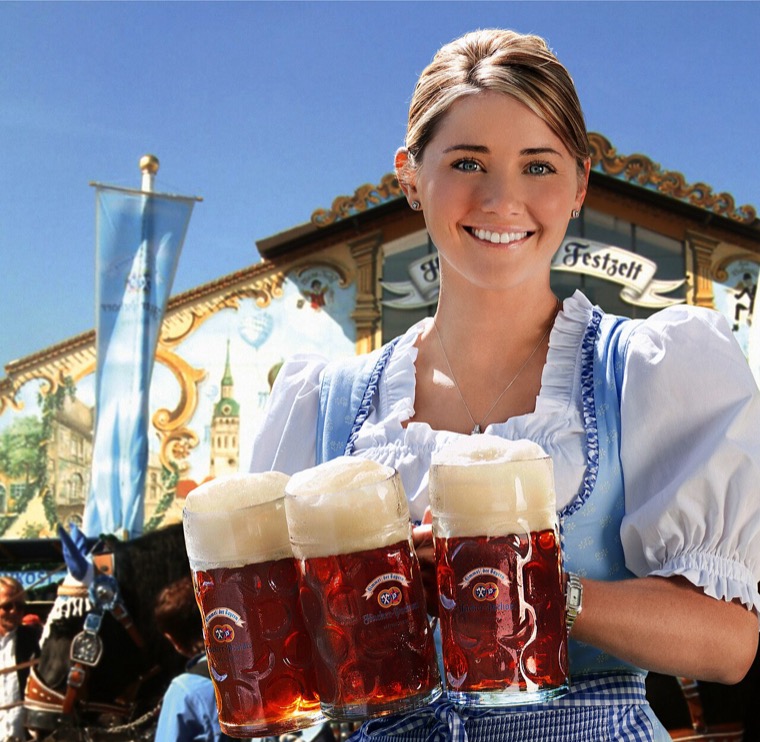
The short version of any Oktoberfest guide is this: entry to the festival grounds and to every beer tent is free, there is no ticket to buy, and the only things you need to book in advance are a bed in Munich and, if you want one, a table in a tent. Oktoberfest 2026 runs from 19 September to 4 October on the Theresienwiese, a litre of beer costs between 14.80 and 15.90 euros, and your bag must be no bigger than three litres.
This guide takes a first-time visitor through the decisions in the order they need to be made, from picking the year and the tent to knowing what time to be standing at the door on a Saturday. The dates, prices and rules come from the organisers' and the City of Munich's own pages, linked in the text, and the rest comes from our years of attending and reviewing the festival for our Oktoberfest listing.
When is Oktoberfest in 2026 and 2027?
Oktoberfest 2026 runs from Saturday 19 September to Sunday 4 October, sixteen days, and opens at noon on the first Saturday when the Mayor of Munich taps the first keg in the Schottenhamel tent. The organisers have already published the 2027 dates, Saturday 18 September to Sunday 3 October 2027, on the Oktoberfest visitor FAQ, which is the page to check before you book anything.
The pattern is stable. The festival always starts on a Saturday in the second half of September and ends on the first Sunday of October, or on 3 October, German Unity Day, if that public holiday falls on the Monday after. The consequence for a first-timer is that you can plan a year ahead with confidence, and in our experience that is exactly what you should do, because the accommodation problem described further down is the one part of the trip that punishes late decisions.
Both weeks are worth considering. The opening weekend and the two Saturdays are the busiest days of the whole festival, and the second week, once the Italian long weekend in the middle has passed, is quieter in the tents on weekday afternoons. If you have a choice, we would take a Tuesday to Thursday in the second week over any weekend.
Do you need tickets for Oktoberfest?
No. The organisers state plainly that access to the festival grounds on the Theresienwiese is free, and the same applies to every beer tent. There is no wristband, no gate ticket and no official ticketing platform for entry, and any site selling you an "Oktoberfest ticket" is selling something else, usually a tour package, a table reservation bought at a markup, or nothing at all.
What you can book is a table. Reservations are handled by each tent individually, through the tent's own website, and the Oktoberfest reservations page explains that the reservation itself is free, just like the visit, but that tents require you to buy vouchers in advance for a minimum consumption, typically two litres of beer and half a chicken per person, with some tents adding a small processing fee per seat. Reservations are taken by the table, not the seat, and a table seats eight to ten people, so a couple cannot reserve on their own without joining a group.
The tents open their reservation systems in spring, by April or May at the latest, and the popular evening and weekend slots go within hours of opening. If you are reading this in September for next year, put a reminder in your calendar for March, follow the tent's own site rather than a reseller, and expect to fill a whole table.
Oktoberfest guide to the tents: how does each one differ?
There are fourteen big tents and each has a distinct character, which is why choosing one is the second decision rather than an afterthought. The organisers keep a page describing all fourteen big tents on oktoberfest.de, and the summaries below add what we have found from sitting in them.
Schottenhamel is where the festival opens, with the tapping of the first keg at noon on the first Saturday, and it draws a young, loud Munich crowd, serving Spaten. Hofbräu-Festzelt is the tent most international visitors have heard of and the one where, in the organisers' words, the party really gets going; it is the only big tent with a standing area in the middle, and it fills with English-speaking visitors early. Hacker-Festzelt, with its painted blue sky ceiling and the slogan "Himmel der Bayern", has the best-known closing singalong of the festival and a mixed local and visitor crowd.
Which tents are calmer, and which are not beer tents at all?
Augustiner-Festhalle is the tent locals will tell you to visit, because the Augustiner beer is still poured from wooden barrels, the tent has its own butcher, and the atmosphere is calmer and more family-oriented than its neighbours. Paulaner Festzelt is the large tent under the rotating Paulaner glass and is a reliable, traditional choice. Löwenbräu-Festzelt, with the roaring lion over the entrance, attracts fans of TSV 1860 Munich and a strong Italian contingent in the middle weekend, and the Pschorr-Festzelt Bräurosl next door is a traditional tent that has been restyled in recent years.
Schützen-Festzelt sits under the Bavaria statue with a flower-decked balcony and has a reputation for a smart, slightly older crowd. Armbrustschützenzelt is named for the crossbow shooting competition still held inside it and serves Paulaner in a relaxed room. Marstall is the newest of the big tents and describes itself as an Oktoberfest living room, with a horse-and-carriage theme and better food than most. Ochsenbraterei is the ox roast, where the day's animals are numbered on a board, and is a good tent for people who care more about eating than singing. Fischer-Vroni serves Augustiner and grilled fish on a stick, and hosts the Pink Monday gathering on the first Monday.
The two exceptions are not really beer tents. Käfer's Wiesn-Schänke is a wooden hut with the feel of an alpine lodge, is where the celebrities and corporate tables sit, and is permitted to stay open until 1 am. Kufflers Weinzelt serves wine, sparkling wine and wheat beer rather than lager, keeps the same 1 am licence, and is the place to go if a litre of Märzen is not your idea of an evening. Our food category covers the tents from that side, because the roast chicken, pork knuckle and pretzels are as much the point as the beer.
How much does beer cost at Oktoberfest 2026?
A Mass, the one-litre glass that is the only size served in the big tents, costs between 14.80 and 15.90 euros in 2026. The City of Munich publishes a full list of beer prices by tent, which shows the Augustiner-Festhalle at 14.90 euros, most big tents at 15.80 euros, and the Armbrustschützenzelt, Bräurosl and Löwenbräu-Festzelt at the 15.90 ceiling. The city checks that prices are reasonable but does not set them.
The organisers' own beer price page adds that this is an average of 2.38 percent higher than 2025, when the range was 14.50 to 15.80 euros, and that the wheat beer in Kufflers Weinzelt costs 18.40 euros. Only beer from the six Munich breweries, Augustiner, Hacker-Pschorr, Hofbräu, Löwenbräu, Paulaner and Spaten, is served on the Wiesn.
Budget beyond the beer. In our experience a first-timer's afternoon and evening in a tent runs to three or four Mass, a plate of food and a tip for the server, which comes to around 80 to 100 euros per person before the rides and the walk home. Cash is still the practical way to pay at the tables, because servers carry change and turn a table faster with it, and the tents' card readers are not always where you are sitting.
What can you bring into Oktoberfest in 2026?
The bag rule is the one that catches visitors at the entrance. The Oktoberfest security page states that bags may be up to three litres in volume, or no larger than 20 cm by 15 cm by 10 cm, and describes what passes as a small handbag or a mini-rucksack. A normal daypack does not get through. There are lockers around the edge of the site but they fill early, so the practical answer is to leave the bag at your accommodation and carry a small crossbody or a bum bag.
The same page bans glass bottles, gas spray cans with harmful contents, and anything that can be used as a cutting, thrusting or stabbing weapon. Drinks in non-glass containers may be brought onto the grounds but not into the tents. Umbrellas, walking aids and medical devices are allowed. Strollers are permitted until 6 pm on most days and not at all on Saturdays or on 3 October.
Our festival packing list treats Oktoberfest as its example of a size-limited day bag, and the list for a tent day is short: a small bag, ID, cash, a phone and a portable charger, a light waterproof layer, and nothing you would mind spilling beer on.
How do you get to the Theresienwiese?
The Theresienwiese is a large open field a short walk south-west of the main station, and the U-Bahn is the way to reach it. The station named Theresienwiese on the U4 and U5 lines opens directly onto the grounds, and the organisers also list Schwanthalerhöhe on the same lines, Goetheplatz and Poccistraße on the U3 and U6, and Heimeranplatz on the U4, U5 and the S7 and S20 S-Bahn lines. On busy evenings Theresienwiese station is closed for crowd control and you will be routed to one of the others, which in our experience adds ten minutes and is not worth worrying about.
From the airport, take the S1 or S8 S-Bahn to the city centre and change; from the Hauptbahnhof it is a fifteen-minute walk down Bayerstraße and Schwanthalerstraße, which most people do at least once. The city warns that the centre and public transport get very busy around the parades on the opening weekend, so allow more time on those two days. Taxis and ride-hail cars do not get close to the entrances and the walk from a drop-off point is often longer than the walk from the U-Bahn.
Buy a day or group ticket for the MVV network rather than singles, because you will make several journeys a day, and keep the ticket accessible at the barrier-free stations, where inspectors work the trains during the festival.
What time should you arrive on weekdays and weekends?
The big tents open at 10 am on weekdays and 9 am on Saturdays, Sundays and 3 October, serve their last beer at 10.30 pm, and close at 11.30 pm, with music running from 11 am on weekdays and 10 am at weekends, according to the organisers' published opening times. Käfer's and the Weinzelt run until 1 am. Those hours decide your day more than anything else in this Oktoberfest guide.
On a weekday without a reservation, arriving between 10 am and 2 pm will get you a seat in almost any tent, because Monday to Friday a quarter of all seats are kept unreserved and the reserved tables are mostly evening bookings that begin at 5 pm. From around 4 pm the servers start clearing the reserved sections and standing is not allowed in the aisles, so if you arrive in the late afternoon without a table you should expect to be moved on. The beer gardens outside each tent are entirely unreserved and are a good fallback while the weather holds.
Weekends are a different exercise. On Saturdays and Sundays 40 percent of seats are unreserved until 3 pm and 25 percent after that, but demand is far higher, and the tents close their doors when full, often by late morning on a fine Saturday. In our experience the only reliable way to sit in a big tent on a Saturday without a reservation is to be in the queue before the 9 am opening, and once inside, to stay. Anyone who leaves the tent at midday on a Saturday will not get back in.
Should you wear Tracht?
Traditional dress, Lederhosen for men and a Dirndl for women, is optional, and nobody will refuse you entry or a seat in jeans and a jacket. The organisers say only that Tracht can be bought at the official Oktoberfest shop or from many Munich costume stores, and in our experience roughly two-thirds of the people in a tent on any given day wear some version of it. Wearing it is a way of joining in rather than a rule.
If you do buy Tracht, buy it in Munich rather than online, because the fit matters and the cheapest sets sold near the station fall apart before the second day. Expect to pay a few hundred euros for Lederhosen and a shirt that will last, and less for a Dirndl at the entry level. Shoes are the part people get wrong. You will stand and walk for many hours on wooden floors and gravel, and comfortable shoes you have already worn in are worth more than a matching pair.
Whatever you wear, dress for a Munich evening in late September, which can be 8 degrees and raining at the moment you leave a tent that was 30 degrees inside. A light jacket that fits under the bench is enough.
When should you book accommodation for Oktoberfest?
Book your bed before anything else, and book it earlier than feels reasonable. Munich hotel prices during the sixteen days of the festival are the highest of the year, and in our experience the reasonably priced rooms within walking distance of the Theresienwiese are gone by the previous December. Booking nine to twelve months out is normal, and with the 2027 dates already published there is no reason to wait.
The trade-off is between distance and price. Anything on the U4 or U5 lines, or within a thirty-minute S-Bahn ride, is close enough; the tents shut at 11.30 pm and the trains run late, so staying in Pasing, Laim or out towards the airport is not a hardship. Campsites and hostel tent villages open on the edge of the city for the festival and are the cheapest option, but check the cancellation terms, because many take full payment in advance.
If you are combining Oktoberfest with other travel, our Germany country page lists the other festivals running in September and October, and the festival calendar shows how the dates line up.
Go for the tent, not the beer
Every Oktoberfest guide ends up describing a queue, and ours is no different. The festival is free to enter, the beer is expensive but not extortionate, the tents are the point, and the whole thing rewards visitors who decide early on a weekday, arrive at opening time and stay at one table for the afternoon. What it does not reward is arriving at 6 pm on a Saturday with a rucksack and an assumption that a ticket exists. The rules above are the organisers' own and are linked; the rest is what we have learned across many Septembers on the Theresienwiese, and our Oktoberfest listing will carry the changes for 2027 as they are published.
Download the Festival Packing Checklist. It includes the Oktoberfest bag limit and a one-page tent-day list, free from the Find a Festival downloads page, and our Oktoberfest listing has the current dates, tent links and transport notes.